
.png)
Solar Panel Installation Safety on Commercial Roofs
Green Hive Editorial Team
March 26, 2022
Refill pouches, solid bars, or returnable aluminum? Three certified haircare brands take three routes past the shampoo bottle. Here is how to pick the one that fits your bathroom.

Green Hive is reader-supported. When you purchase through links on our site, we may earn an affiliate commission. To understand our thorough approach to rating brands and products, explore our comprehensive methodology.
Green Hive is reader-supported. When you purchase through links on our site, we may earn an affiliate commission. To understand our thorough approach to rating brands and products, explore our comprehensive methodology.
Pick up a bottle of shampoo and look at the parts: a plastic body, a pump made of several plastics and a metal spring, a label, and a residue of product you will never get out. That combination makes haircare packaging one of the harder categories to recycle, whatever the symbol on the base says. Globally, only around 9% of plastic waste is actually recycled, according to the OECD's Global Plastics Outlook, and mixed-material containers are among the items most likely to fall out of the system.
A growing number of refillable and low-waste haircare brands have responded by redesigning the packaging rather than the recycling instructions. This article looks at three that took different routes: amika with refill pouches, Ethique with solid bars, and Plaine Products with returnable aluminum bottles. Each has trade-offs, and the right one depends on how you wash your hair, where you live, and how much friction you will tolerate.
Most shampoo bottles are HDPE or PET, both technically recyclable. The trouble sits in everything around them. Pumps combine polypropylene, a stainless steel spring, and sometimes a glass ball, which most municipal facilities will not separate. Conditioner leaves a coating inside the bottle that contaminates bales if not rinsed. Colored or opaque plastics fetch lower prices and are more likely to be landfilled when markets are weak.
Bathroom habits compound the problem. Bathroom bins are often a single mixed container, so bottles that would be sorted correctly in the kitchen go straight to general waste. Travel sizes and sachets add material that no curbside program accepts.
The result is that a household can do everything right at the curb and still see much of its bathroom plastic end up as waste. Reducing the number of bottles entering the system in the first place is a more reliable strategy than improving what happens to them afterward. That is the logic behind all three brands below, even though each applies it differently.
amika is a Brooklyn-based salon haircare brand built around sea buckthorn as its signature ingredient. Green Hive has reviewed the brand previously, and its sustainability approach centers on keeping the liquid format most people are used to while cutting the plastic behind it.
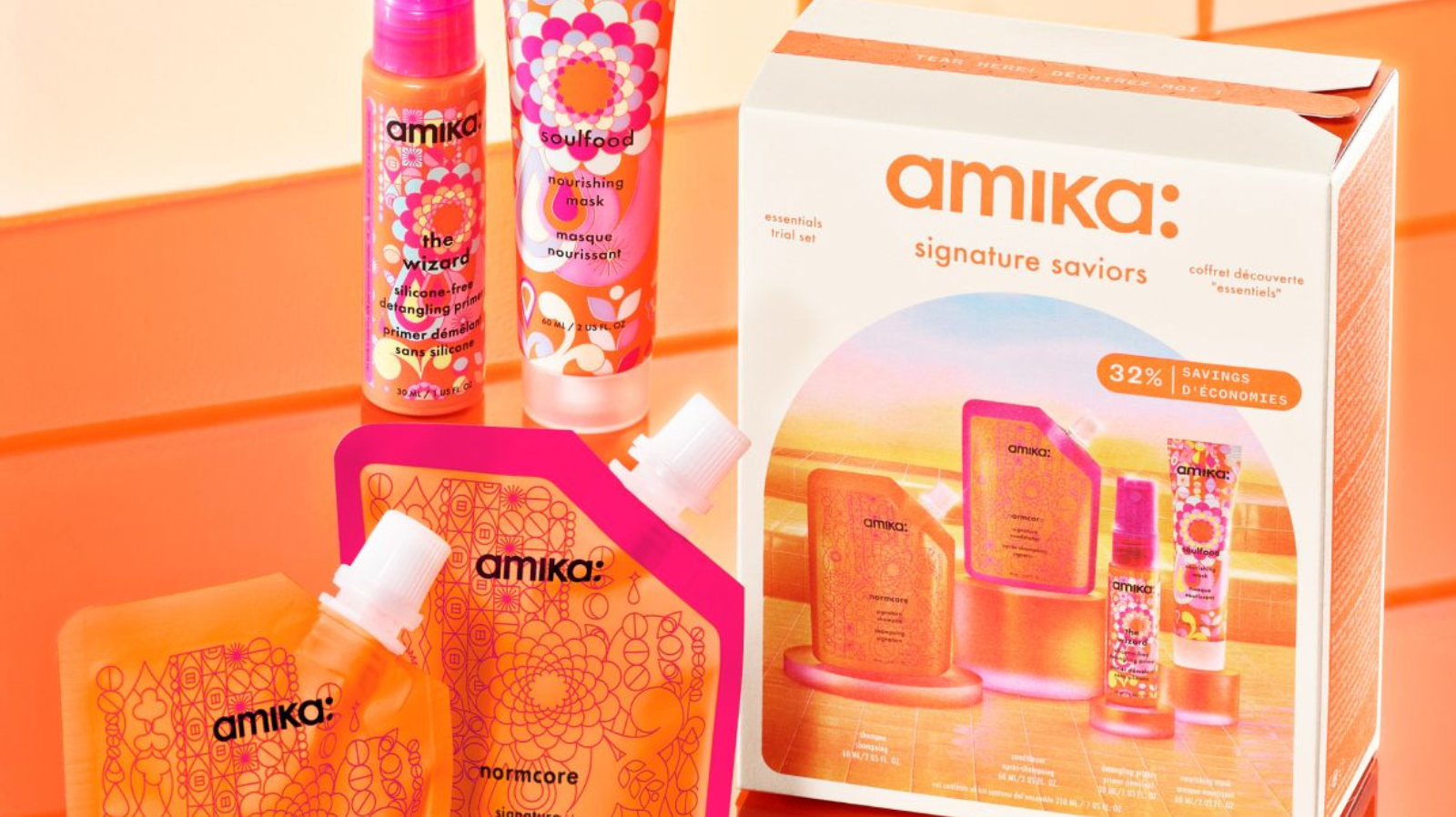
The core of that approach is refill pouches for its best-selling shampoos and conditioners, launched in 2022. You keep your original bottle (or one of the brand's Forever Friend refillable bottles) and top it up from a flexible pouch. amika reports that a pouch cuts carbon emissions by 98.4% compared with a virgin plastic bottle over a year of use, a brand figure that reflects how much lighter and less material-intensive a pouch is than a rigid container. Bottles in the core range now use up to 90% post-consumer recycled plastic, according to the brand, and amika runs a free take-back program for pumps, caps, and pouches that curbside recycling will not accept.
On credentials, amika is a Certified B Corporation, holds B Corp status since March 2023, is Leaping Bunny certified for cruelty-free status, and is carbon neutral certified through Climate Neutral, with a stated pledge to reach net zero by 2035. Those are verifiable third-party markers rather than marketing language, which is the standard Green Hive applies before recommending a brand.
The trade-off is that pouches are still plastic, and the brand has been open that it chose PCR plastic over glass or aluminum on lifecycle grounds. If your goal is zero plastic, this is not that. If your goal is to keep using a liquid shampoo you like while removing most of the packaging, it is the most accessible route of the three. amika is widely stocked at Sephora and Ulta in the US, and the same bottle can vary in price by retailer, as amika's current retailer pricing shows. That matters for a refill system, since the saving only holds if the refill costs less per wash than a fresh bottle.
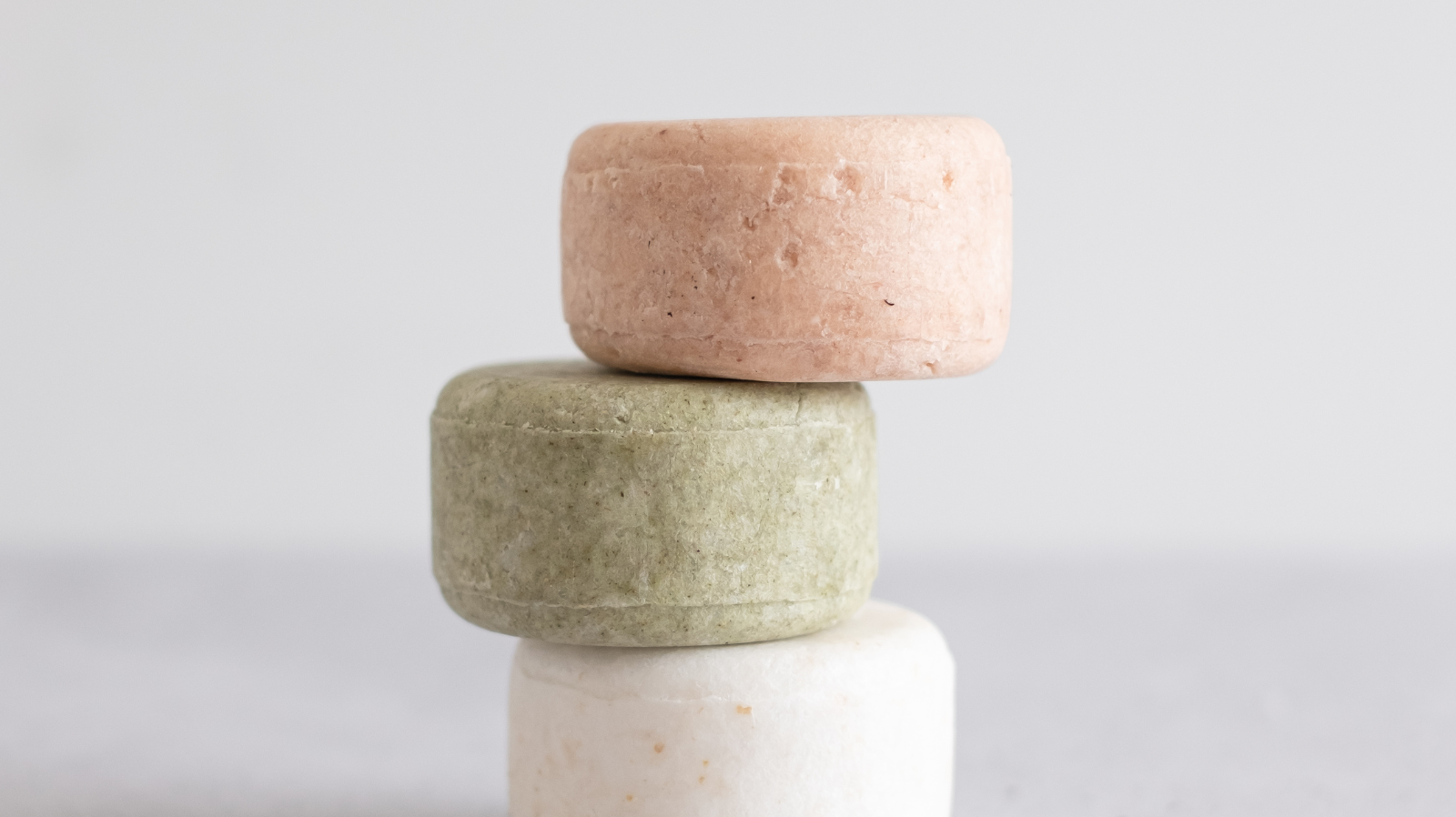
The New Zealand brand Ethique took the opposite view: if the bottle is the problem, get rid of it. Its shampoos and conditioners are solid concentrated bars sold in compostable card packaging, with no plastic anywhere in the product or the box.
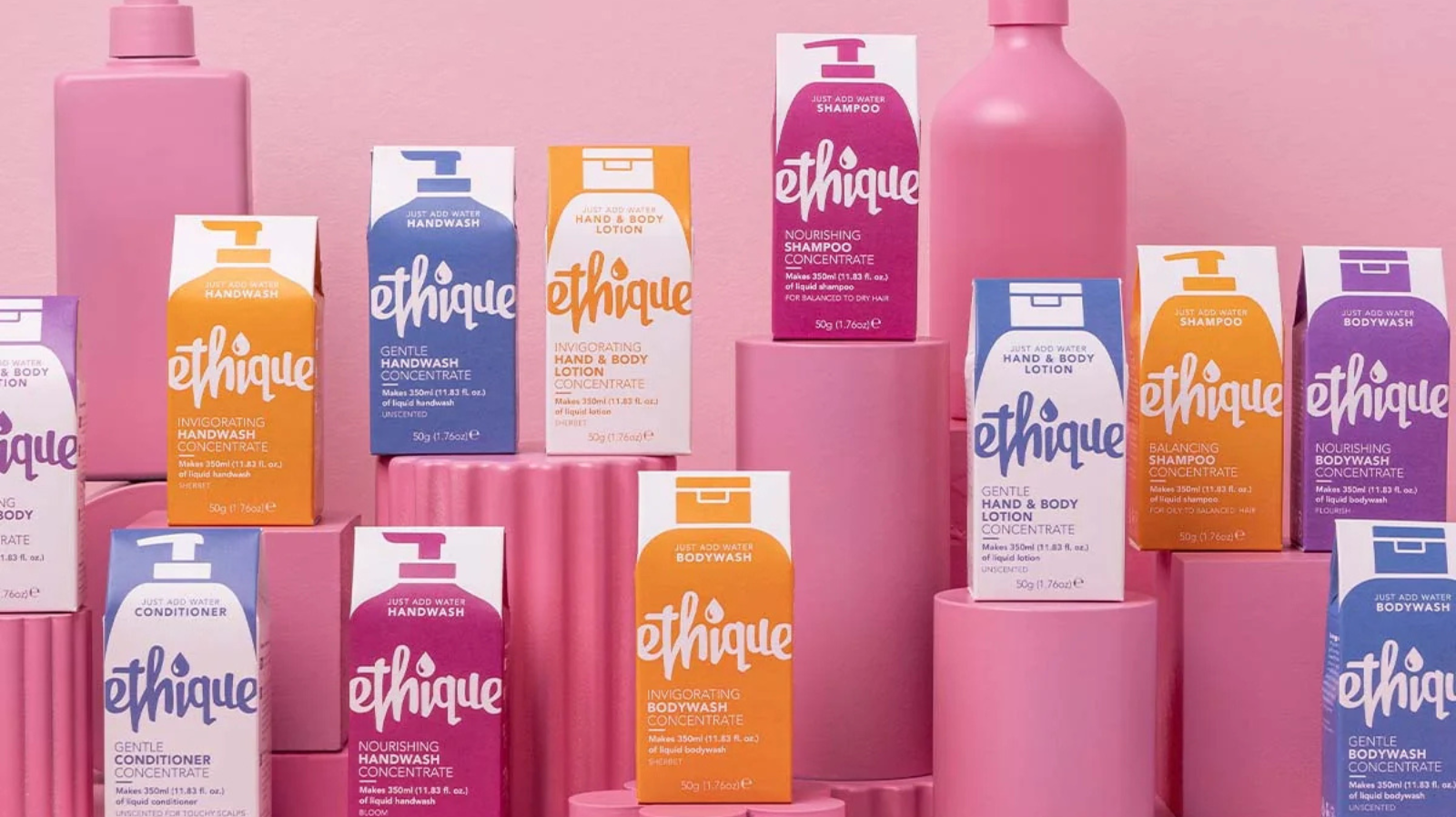
Because the water has been removed, a bar is far lighter to ship and far denser in product. According to Ethique, one shampoo bar is equivalent to roughly three bottles of liquid shampoo, which also means fewer purchases and fewer deliveries over a year. The brand is a Certified B Corp with publicly listed impact scores, Leaping Bunny certified, and certified palm oil free. It describes itself as climate positive and commits to donating 2% of revenue or 20% of profit, whichever is higher, to charity, both of which are brand statements rather than independently rated certifications.
The trade-off here is behavioral. Bars need to dry between uses or they dissolve quickly, so a draining soap dish is essential. Some people find their hair needs a transition period, particularly if they are switching from silicone-heavy conditioners. And formulation matters: Ethique's bars are soap-free and pH-balanced, which is what separates a shampoo bar from a bar of soap used on hair. If you can adapt to the format, it is the lowest-packaging option available.
Plaine Products, founded in the US in 2017, sits between the two. Its shampoos, conditioners, and body care come in aluminum bottles with a reusable pump. When you run low, you order a refill bottle, transfer the pump, and send the empty back to the company for cleaning and reuse using the box your refill arrived in.
This is a true closed loop rather than a recycling loop, and it is the most circular of the three models. The company has been a Certified B Corp since January 2018, every formula is Leaping Bunny certified, it donates through 1% for the Planet, and its products are palm oil free and vegan. According to the brand, formulas are made in the US with a small domestic manufacturer.
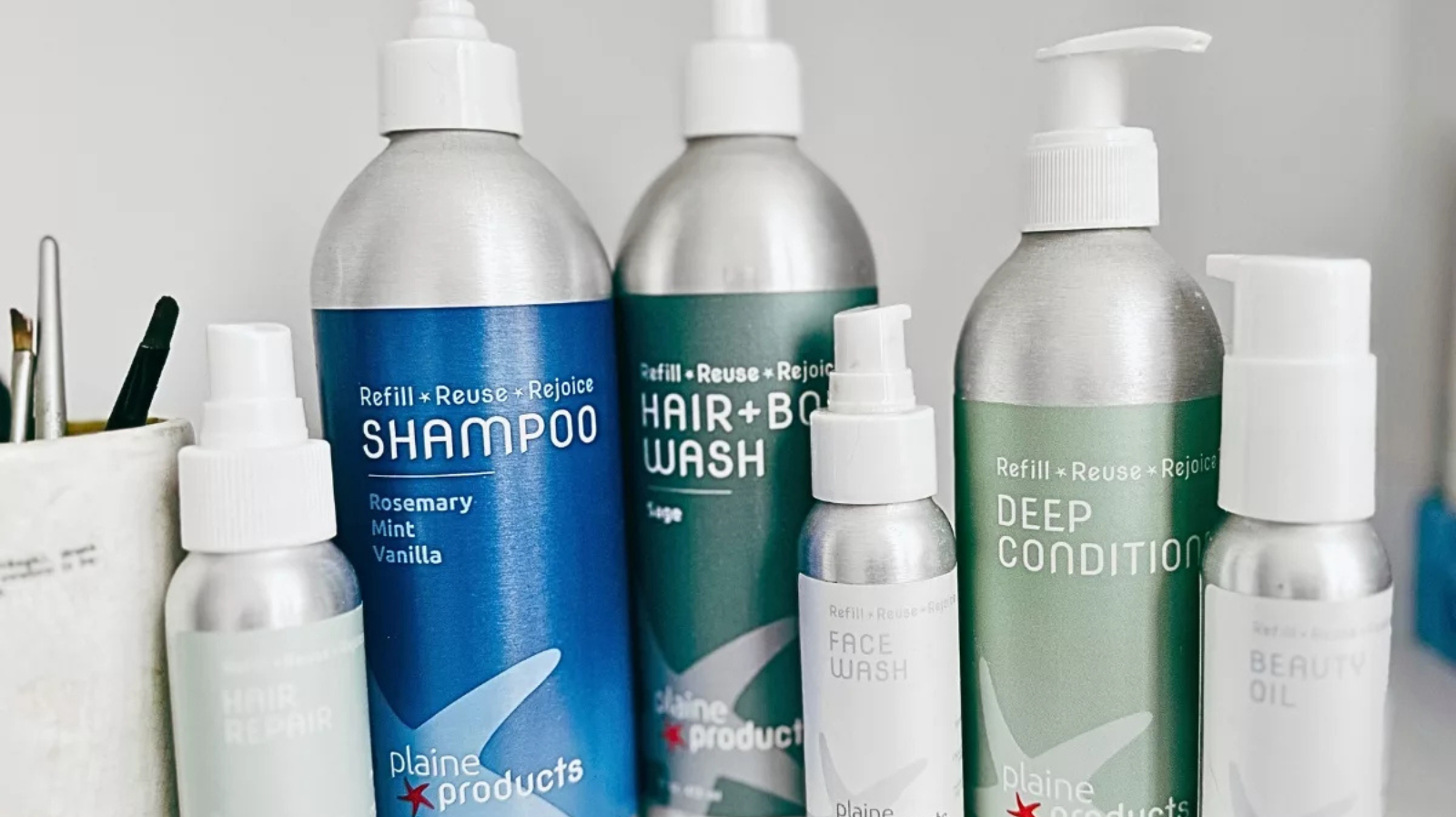
The trade-offs are geography and follow-through. Plaine Products ships to US customers only, so this is not an option for most Green Hive readers outside North America. And the system only works if you return the bottles. An aluminum bottle that ends up in a drawer has a higher production footprint than the plastic it replaced. If you are organized enough to batch returns, it is an excellent choice. If not, the aluminum can at least be recycled curbside, which is more than can be said for a shampoo pump.
Refill pouches (amika): best for people who want to keep a familiar liquid product and buy in mainstream stores. Pouches are still plastic, so use the take-back program for full recycling.
Solid bars (Ethique): best for travelers, minimalists, and anyone aiming for zero plastic. You will need a draining dish, and some hair types go through a short transition period.
Returnable aluminum (Plaine Products): best for US households happy to batch and mail returns. US only, and the benefit depends on actually sending the bottles back.
Two practical questions settle most decisions. If you travel often or share a small bathroom, the bar wins on space. If your current formula works for color-treated or fine hair, a pouch keeps it while cutting the packaging.
Whichever you choose, apply the same rule Green Hive readers already use for spotting greenwashing: look for the certification, not the adjective. All three brands here hold B Corp status and Leaping Bunny certification, both rated in Green Hive's certifications database, which is why they made the list. Plenty of "eco" haircare does not.
The shampoo bottle is a small object with an outsized recycling problem. The encouraging part is that the industry has produced three workable answers to it, each suited to a different kind of household. amika keeps the liquid and shrinks the packaging. Ethique removes the packaging by removing the water. Plaine Products keeps the bottle in circulation instead of in the bin.
The wrong choice is the one that ends up abandoned. Pick the refillable haircare format that fits how you actually live, use it until it runs out, and repurchase on a predictable cycle. That habit, more than any material, is what takes bottles out of the waste stream.
On packaging alone, yes: a bar in card packaging contains no plastic at all, while a pouch is a flexible plastic film. Bars are also lighter to ship. Pouches win on convenience and on keeping a product you already know works for your hair, so the better choice is the one you will stick with.
Usually not through curbside collection. Pumps combine several plastics with a metal spring and most facilities will not separate them. Brand take-back programs, such as the one amika runs, are the reliable route.
The upfront price is often higher, but refills and concentrated bars typically work out cheaper per wash than repeatedly buying full bottles. Comparing the cost per use, rather than the shelf price, gives a fairer picture.
OECD. (2022, February 22). Global Plastics Outlook: Economic drivers, environmental impacts and policy options. OECD Publishing. https://www.oecd.org/en/publications/2022/02/global-plastics-outlook_a653d1c9.html
B Lab. (n.d.). Amika: Certified B Corporation. https://www.bcorporation.net/find-a-b-corp/company/amika
B Lab. (n.d.). Plaine Products: Certified B Corporation. https://www.bcorporation.net/en-us/find-a-b-corp/company/plaine-products
amika. (n.d.). Sustainability. https://loveamika.com/pages/sustainability
Ethique. (n.d.). B Corp. https://ethique.co.nz/pages/b-corp
Plaine Products. (n.d.). What is a B Corporation and why does it matter? https://www.plaineproducts.com/what-is-a-b-corporation-and-why-does-it-matter





.svg)
