
.png)

Refillable and Low-Waste Haircare: Three Brands That Rethought the Bottle
Green Hive Editorial Team
June 21, 2023
Rail, a short-haul flight and a seven day river cruise on one 850 km route. Same rules, honest numbers, and a clear answer on which is the low-carbon way to travel.


Green Hive is reader-supported. When you purchase through links on our site, we may earn an affiliate commission. To understand our thorough approach to rating brands and products, explore our comprehensive methodology.
Green Hive is reader-supported. When you purchase through links on our site, we may earn an affiliate commission. To understand our thorough approach to rating brands and products, explore our comprehensive methodology.
KEY TAKEAWAYS
Those three options are routinely compared in travel writing as though they are alternatives. They are not, and the honest comparison is more interesting than the flattering one.
Here is what the numbers actually show on a single route, and what has to be held constant to make the comparison fair.
Most published comparisons fall apart on methodology rather than data.
Three decisions matter. Whether aviation's non-carbon effects are counted. Whether the figure covers transport alone or the whole trip. And whether occupancy is assumed at capacity or at realistic load.
The first is the one that swings results most. A study commissioned by the European Environment Agency found a clear hierarchy across passenger modes, with rail and waterborne transport lowest per kilometer and unit transported, and aviation and road significantly higher.
That study applied a Global Warming Potential weighting of 1.7 to direct CO2 from flights, to account for non-CO2 radiative forcing at altitude. Comparisons that omit that adjustment understate flying by a meaningful margin.
For the baseline figures, compiled data at Our World in Data puts national rail at around 35 grams of CO2 per passenger-kilometer against roughly 154 grams for a short-haul flight, with Eurostar as low as 4 grams on a heavily decarbonized electricity supply.
Short flights are disproportionately intensive because takeoff consumes far more energy than cruising. An 850 kilometer hop spends a large share of its fuel simply getting airborne.
The river option needs stating carefully, because it is not a transport product at all.
.jpg)
Celebrity Cruises groups its spring sailings through the Netherlands and Belgium into a set of bloom itineraries, and tulip season cruises of that kind let you experience the season across the bulb region, Keukenhof and the canal towns over roughly a week, with the vessel serving as accommodation throughout.
That is the crux. A river ship is your transport, hotel, restaurant, bar and entertainment for seven days. Its emissions figure covers all of it.
Comparing that total against a flight is comparing a week of living against ninety minutes of movement. Any article that does so, in either direction, is producing a number that means nothing.
The defensible comparison for a river sailing is against another week-long holiday, counted the same way.
Using the 850 kilometer route, and being explicit about what each figure includes:
For the river figure, analysis commissioned by Friends of the Earth from Energy and Environmental Research Associates estimated emissions per passenger day for a typical river cruise at 176 kg of CO2 on a 1,500 gross ton vessel carrying around 128 passengers, rising to 338 kg on a 3,500 gross ton vessel carrying around 200.
Across seven days that produces something in the range of 1,200 to 2,400 kg per passenger.
Even accounting for everything the sailing includes, that is not close to the rail figure. It is not close to the flight figure either.
Three factors drive it, and none of them are scandalous.
Small vessels carry few passengers, so fixed energy demand divides across a small denominator. A hundred and twenty people are running a hotel's worth of heating, cooling, lighting, laundry and catering between them.

Hotel load is substantial. Roughly a third of a cruise vessel's energy use is typically the onboard electrical demand rather than propulsion, and that draw continues while moored.
And the fuel is marine diesel rather than a decarbonizing electricity grid. Rail improves automatically as national generation gets cleaner. A vessel does not.
There is a real distinction worth preserving, though. The same Friends of the Earth analysis found river cruising yields roughly 20 to 58 percent lower emissions per passenger day than prior estimates for ocean cruising, because river vessels are smaller, use cleaner fuel and carry less operational load.
Against ocean cruising, river is a genuine improvement. Against rail, it is not, and no amount of framing changes that.
If the question is how to spend a week rather than how to cross a distance, the picture shifts somewhat.
The ICCT has found that passengers on even the most efficient ocean cruise ships emit twice as much CO2 as someone who flies to a destination and stays in a high-end hotel.
Apply the river discount to that and a river week lands somewhere in the region of a fly-and-hotel week, depending heavily on vessel size and occupancy.
Which is the honest position. A river sailing is roughly comparable to a conventional flying holiday, better than an ocean cruise, and considerably worse than a rail-based trip with land accommodation.
The practical guidance separates cleanly by question.
For getting between two European cities under about 1,000 kilometers, take the train. Rail's advantage is large, well documented and improving. The EEA's own trajectory data shows rail direct emissions falling substantially over three decades while passenger activity rose.
For a sub-700 kilometer hop, avoid flying specifically. That is the least efficient aviation there is.
For a week of holiday, count the whole week. Accommodation, meals, transfers and activities all carry footprints, and a river sailing bundles them into one number that looks alarming precisely because it is complete.
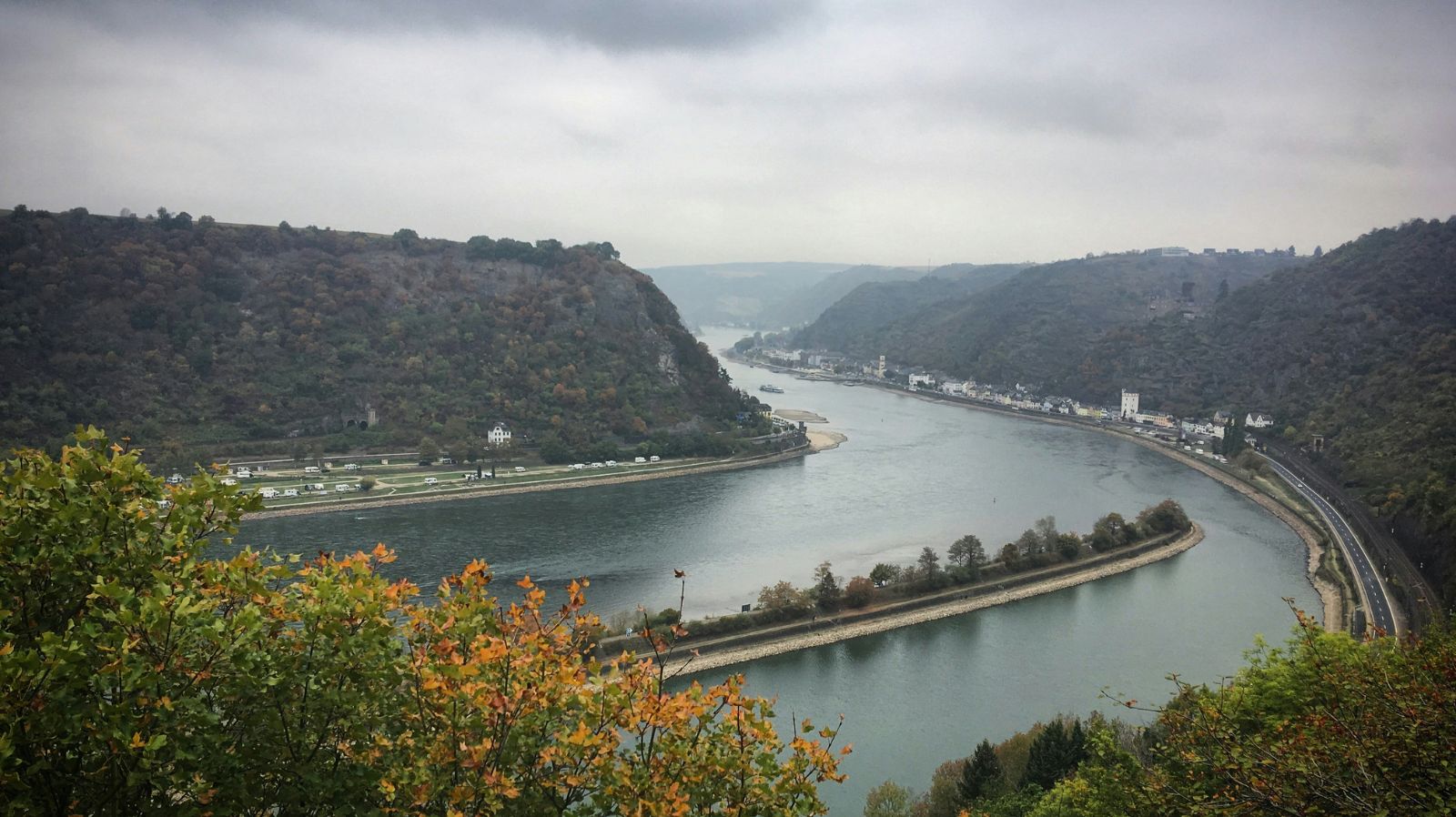
And if the river landscape is the point of the trip, book it for that reason. It is a legitimate way to see the Rhine and the bulb fields. It is simply not the low-carbon way to travel, and readers deserve to be told which question they are answering.
European Environment Agency. (2021, March 24). Rail and waterborne: Best for low-carbon motorised transport. https://www.eea.europa.eu/en/analysis/publications/rail-and-waterborne-best-for-low-carbon-motorised-transport
International Council on Clean Transportation. (2025, June). Cruise the seas or cruise down the road? A fresh look at vacation emissions. https://theicct.org/cruise-the-seas-or-cruise-down-the-road-a-fresh-look-at-vacation-emissions-jun25/
Ritchie, H. (2023). Which form of transport has the smallest carbon footprint? Our World in Data. https://ourworldindata.org/travel-carbon-footprint
Williams, R. (2025, September 4). What are the best river cruises for the environment? Friends of the Earth. https://foe.org/blog/what-are-the-best-river-cruises-for-the-environment/






.jpg)

.svg)
